
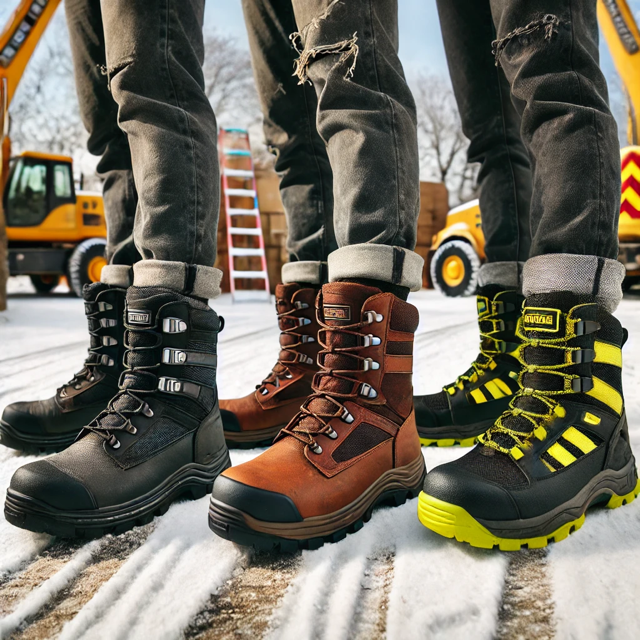
Cold-Resistant Work Boots for Arctic Conditions: Extreme Protection in 2025
Working in freezing environments demands equipment that performs flawlessly under pressure — and cold-resistant work boots are built to meet that challenge. Designed for extreme winter and Arctic conditions, these boots protect against frostbite, moisture, and impact while ensuring warmth and comfort. At Optimum BHP, you’ll find heavy-duty footwear from Portwest, Delta Plus, and Procera — all engineered to keep workers safe in temperatures as low as –30°C. With reinforced materials, multi-layer insulation, and SRC-certified soles, these boots are the ultimate shield for outdoor professionals facing the harshest European winters.
Continue reading on our blog:
Procera Winter Workwear for Truck Drivers and Long-Haul Transport Crews: Comfort and Functionality on the Road
Latex-Coated Winter Gloves Compared: COVENT FROST vs COVENT YETI vs COVENT BOA (Polstar)
Procera Reflective Workwear: Budget-Friendly Hi-Vis Jackets and Pants for Everyday Jobs
CXS Canis Winter Workwear for Outdoor Logistics and Delivery Drivers – Insulated Mobility Set
Art-Mas Reflective Workwear: Practical Hi-Vis Safety for Everyday Industrial Use in 2025
Thermal Safety Boots for Warehouse and Logistics Workers: Balancing Warmth, Grip, and Flexibility in 2025
⸻
The Science of Cold Resistance
Cold-resistant safety boots use advanced multi-layer insulation systems to retain warmth while maintaining flexibility. Portwest integrates Thinsulate™ and fleece linings, while Delta Plus adds aluminum-reflective barriers that reflect body heat inward. Procera combines waterproof outer shells with breathable thermal membranes. Together, these elements trap heat and block cold air — keeping feet warm without overheating. Every model at Optimum BHP meets EN ISO 20345 S3 or CI standards for cold insulation, ensuring certified protection even in subzero working environments.
⸻
Features Designed for Arctic Work
Extreme cold requires more than just warmth — it demands durability and precision. Base Protection and Uvex produce lightweight composite boots with shock-absorbing midsoles and non-metallic insulation. CXS Canis offers reinforced soles that maintain flexibility at –25°C, while Procera designs high-cut collars that block snow and wind. Delta Plus models include thermal footbeds and reflective inserts that preserve internal heat. These boots are perfect for outdoor work in polar logistics, mining, or infrastructure maintenance — where failure is not an option.
⸻
Durability and Safety in Extreme Environments
Arctic-grade work boots are built to resist cracking, stiffening, and material fatigue under subzero stress. Portwest uses reinforced leather uppers and double-stitched seams that repel water and ice. Procera integrates puncture-resistant midsoles for added safety on frozen terrain. Anti-slip SRC soles from Delta Plus provide grip even on icy steel or concrete. These models maintain stability, flexibility, and traction when ordinary footwear would freeze and fail — keeping workers safe from slips and hypothermia.
⸻
Comfort and Ergonomic Design in Cold Climates
Despite their rugged design, cold-resistant boots can be surprisingly comfortable. Base Protection and Uvex prioritize ergonomics, with cushioned insoles, moisture-wicking linings, and shock-absorbing soles. Lightweight composite materials reduce fatigue during long shifts. Breathable membranes prevent sweat accumulation, ensuring dry feet throughout the day. For outdoor workers exposed to both cold and moisture, these models deliver unmatched warmth-to-weight ratio — combining safety, agility, and comfort in one professional solution.
⸻
Sustainability and Arctic-Ready Innovation
Eco-friendly production has become a key focus in PPE manufacturing. Cofra and Lemaitre use recycled insulation fibers and low-impact adhesives. Base Protection implements biodegradable soles and renewable linings that maintain full cold resistance. Optimum BHP supports sustainable innovation — ensuring that today’s protection does not come at tomorrow’s environmental cost. Arctic-ready safety boots now combine high performance with responsible materials, leading the next evolution of winter PPE.
⸻
FAQ – Cold-Resistant Work Boots
1. How cold can Arctic work boots handle?
Up to –30°C, depending on insulation and lining type.
2. Are cold-resistant boots waterproof?
Yes — most include waterproof membranes and sealed seams.
3. Which brands offer the best Arctic models?
Portwest, Procera, and Delta Plus.
4. Are insulated boots breathable?
Yes — they wick moisture while maintaining warmth.
5. Do cold-resistant shoes have anti-slip soles?
Yes — all certified models feature SRC-rated traction systems.
6. Are these boots suitable for electricians?
Yes — non-metallic versions from Uvex are non-conductive.
7. Do they protect against punctures and shocks?
Yes — all S3 and CI-rated models include reinforced midsoles and toe caps.
8. Can I use Arctic boots indoors?
Yes, if the space is unheated or exposed to low temperatures.
9. Do these boots freeze or stiffen over time?
No — advanced rubber and PU compounds stay flexible in subzero conditions.
10. Are Arctic safety boots heavy?
Modern composites make them much lighter than older steel models.
11. How long do cold-resistant boots last?
Typically 24–36 months under heavy outdoor use.
12. Are there eco-friendly Arctic models?
Yes — Cofra and Base Protection lead in sustainable winter PPE.
13. How do I maintain Arctic work boots?
Clean regularly, dry naturally, and reapply waterproofing agents.
14. Can I wear Arctic boots in wet conditions?
Yes — they’re designed for snow, slush, and rain.
15. Where can I buy certified cold-resistant boots?
At Optimum BHP — Europe’s trusted source for Arctic-grade safety footwear.